Bulgaria/Music/Instruments Pg 4
Tanbura
A folk instrument of the chordophone family of supposedly Turkish or Persian-Arab origin, the tanbura is found mainly in the south east of Bulgaria and in the mountainous Pirin region.
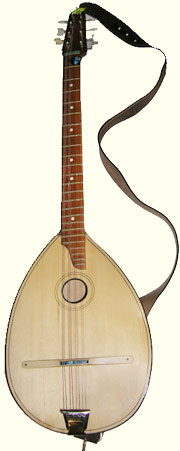
The tanbura is a piriform lute with a body made of sycamore or pear wood. The soundboard has two or more sound holes. The instrument has a long neck with a straight fingerboard and keys to adjust the string tension. The strings pass over the bridge and are held in place by a piece of beech wood called a "button". The number of frets can vary between 12 and 18, depending on the dimensions and type of tanbura. They are placed all along the keyboard and are made of metal, string, sheep gut or linen thread. The tanbura strings are metal, wrapped with copper thread that makes the tone soft and tender. The strings are plucked with a small cherry bark plectrum to produce the sound.
Bulgarian tanbura come in different sizes, with different numbers of strings, in different tunings and are played in various positions. Today, the best known tanbura has 8 strings, 18 frets, chromatic tuning and a wide range.
In the past, only men played the tanbura to accompany their songs. In modern orchestras and groups, the tanbura most often plays harmony or rhythm. Nonetheless, accomplished musicians can play solos of remarkable technique and virtuosity.

© Gans 2011