Bulgaria/Music/Instruments Pg 6
Tupan
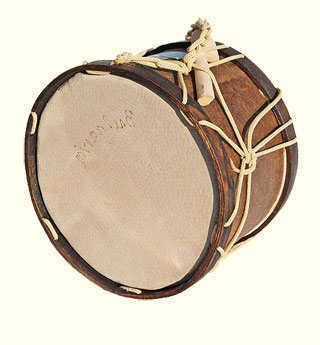
The tupan is a percussion membranophone with two vibrating bodies. It has a cylindrical wooden body on which two goat or sheep skins are stretched by means of a hoop and lacing. The tupan is held in front of the player, suspended over the shoulder by a long strap attached to the drum.
The drum is hit with two different sized drumsticks. The right hand holds the larger and fatter stick with the padded end called the tokmak. The other stick in the left hand is smaller and thinner. The large drumstick beats out the measure, while the small switch plays quicker rhythms thus allowing the musician to play complex combinations.
The tupan is of foreign origin but is nonetheless deeply rooted in Bulgarian musical life. It is found throughout the south west and in the Standja Mountains region. The rhythmic deep sound of the drum is heard during weddings, village dances, bear folk games, the performances of koukers (traditional Bulgarian masques) and the nestinar (dancers who walk on hot coals).
The tupan is primarily an accompanying instrument that marks the rhythm but it can also be played as a solo instrument. Well-tuned and with good acoustic construction, it has a beautiful tone. An accomplished musician can get sounds from it not only by hitting the different sections of the drum heads but also by hitting the hoops and the body or even by rubbing the skins (friction percussion).
In modern folk groups, the tupan is usually used to mark the beat. On the other hand, it can be played as a solo instrument to emphasize an important moment in a dance.

© Gans 2011