Russia/Music
Ethnic Russian music specifically deals with the folk music traditions of the ethnic Russian people. It does not include the various forms of art music, which in Russia often contains folk melodies and folk elements.
The roots of Russian folk music can be dated as far back as to the first millennium AD, when Slavic tribes first settled in the European part of what is presently Russia. In Greek chronicles state that in 591 the Avar khan sent Slav's were captured who had musical instruments (kitharas often thought to be gusli) players.
Ethnic styles in the Modern
The performance and promulgation of ethnic music in Russia has a long tradition. Initially it was intertwined with various forms of art music, however, in the late 19th century it began to take on a life of its own with the rise in popularity of folkloric ensembles, such as the folk choir movement led by Mitrofan Pyatnitsky and the Russian folk instrument movement pioneered by Vasily Andreyev.
In Soviet Russia, folk music was categorized as being democratic (of the people) or proletarian (of the working class) as opposed to art music, which was often regarded as being bourgeois. After the revolution, along with Proletarian "mass music" (music for the proletarian masses) it received significant support from the state. In Post World War II Russia, Proletarian mass music however lost its appeal, whereas folkloric music continued to have a widespread support among the population, inside and outside of the Soviet Union. However the authentic nature of folk music was severely distorted by the Stalinist drive to 'professionalize' performers, regardless of the genre they worked in: thus all folk singers were obliged to both learn Western-style classical notation, and to learn to perform classical repertoire - or else risk losing their right to perform as 'professionals'.
In the 1960s folk music in Russia continued to receive significant state support and was often seen as the antithesis of Western pop music. The fact that numerous Soviet folkloric ensembles were invited for foreign tours raised the prestige of the folk performer to that of academic musicians, and in some cases even higher because access to the West and Western goods was very desirable.
Ethnic (folk) music in Russia can often be categorized according to the amount of authenticity in the performance: truly authentic folk music (reproductive performances of traditional music), folkloric and fakeloric performance.
Authentic folk music
This music is closely tied in with the village life and traditions. It was usually not performed by music professionals. From the Central Committee's resolution of 1932, which prescribed musical literacy (in parallel to the drive to industrialize the Soviet Union), there has been a marked decline in authentic folk performance practice. Festivals, competitions and the work of ethnomusicologists have made attempts at preserving what has survived. In recent times there has been a movement by musicologists to study and reproduce authentic folk music in an authentic performance style on the concert stage.
Pictured below is a more modern balalaika orchestra complete with woodwinds and percussion.
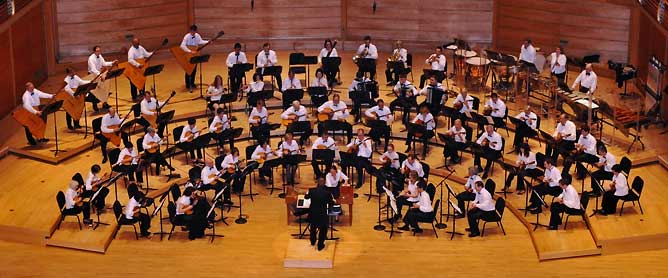
Sample of large folk orchestra recording from the Soviet era.
Under the apple tree
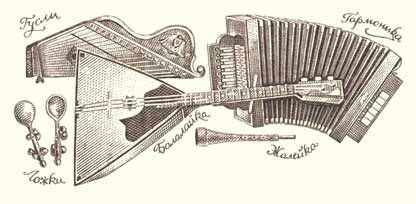
You can find information on individual musical instruments that are
typical to Russian Folk Groups and Orchestras here: Instruments Page 1 »

© Gans 2011